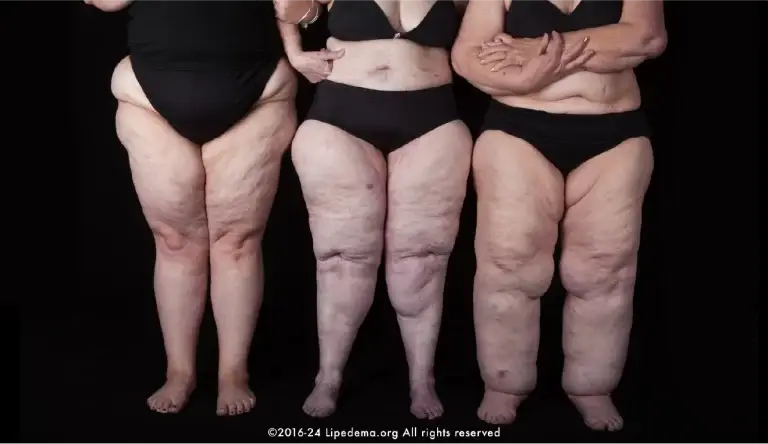
Berlin, July 17, 2025 – In a landmark decision, Germany’s Federal Joint Committee (G-BA) has approved public health insurance coverage of liposuction for patients with lipedema in stages I, II, and III. This marks a major shift in international policy and was based directly on the scientific findings of the LIPLEG study, the first multi-center, randomized, controlled, and blinded clinical trial evaluating liposuction in lipedema care. “Today is a great day for all of us,” said Dr. Mojtaba Ghods, lead investigator of the LIPLEG study and Chair of the Lipedema Task Force in Germany. “This decision is the result of over a decade of advocacy, science, and listening to patients.” Read More >> Disclaimer:These documents are unofficial translations of materials originally published by the Gemeinsamer Bundesausschuss (G-BA). They have been translated by Lipedema Canada for the sole purpose of improving access to information for the Canadian and international lipedema community. No information has been altered or modified by Lipedema Canada during the translation process. However, errors or nuances in language translation may occur. These documents do not represent the opinions or positions of Lipedema Canada, but are intended solely as direct translations of the original G-BA materials. The G-BA is not responsible for the content or accuracy of these translations. For the official German versions, please refer to the original publications available on the G-BA website: https://www.g-ba.de LIPLEG Study: What You Need to Know Link to the Study: https://pubmed.ncbi.nlm.nih.gov/34717741/ What is the LIPLEG study? The LIPLEG study is the largest …
Berlin, July 17, 2025 – In a landmark decision, Germany’s Federal Joint Committee (G-BA) has approved public health insurance coverage of liposuction for patients with lipedema in stages I, II, and III. This marks a major shift in international policy and was based directly on the scientific findings of the LIPLEG study, the first multi-center, randomized, controlled, and blinded clinical trial evaluating liposuction in lipedema care.
“Today is a great day for all of us,” said Dr. Mojtaba Ghods, lead investigator of the LIPLEG study and Chair of the Lipedema Task Force in Germany. “This decision is the result of over a decade of advocacy, science, and listening to patients.”
Disclaimer:
These documents are unofficial translations of materials originally published by the Gemeinsamer Bundesausschuss (G-BA). They have been translated by Lipedema Canada for the sole purpose of improving access to information for the Canadian and international lipedema community.
No information has been altered or modified by Lipedema Canada during the translation process. However, errors or nuances in language translation may occur.
These documents do not represent the opinions or positions of Lipedema Canada, but are intended solely as direct translations of the original G-BA materials. The G-BA is not responsible for the content or accuracy of these translations.
For the official German versions, please refer to the original publications available on the G-BA website: https://www.g-ba.de
LIPLEG Study: What You Need to Know
Link to the Study: https://pubmed.ncbi.nlm.nih.gov/34717741/
What is the LIPLEG study?
The LIPLEG study is the largest and most rigorous clinical trial to date evaluating liposuction as a treatment for lipedema. Conducted in Germany and involving over 400 women with confirmed stage I–III lipedema, this randomized, controlled study compared liposuction to conservative treatments like compression and decongestive therapy.
LIPLEG was commissioned by the German Federal Joint Committee (G-BA) to evaluate whether liposuction is a safe and effective treatment for lipedema.
Who was in the study?
410 women with confirmed stage I, II, or III lipedema in the legs
All had significant pain (4 or higher on a 0–10 scale) and had not improved with conservative treatments like compression and lymphatic therapy
What was measured?
This was a randomized controlled trial (RCT), which is the gold standard in medical research. Participants were assigned randomly into two groups:
- Liposuction Group (278 people):
Received up to four surgical liposuction treatments spaced 5–7 weeks apart - Conservative Therapy Group (132 people):
Continued with complex physical decongestive therapy (CPT), including compression, lymph drainage, and exercise
Both groups started with a run-in phase to ensure everyone had received standardized non-surgical care before surgery began.
How was the study done?
Researchers tracked key patient-reported outcomes at 12 months, including:
- Pain levels
- Mobility and function
- Depression symptoms
- Quality of life (physical and mental)
How long did the study last?
- Start of recruitment: Early 2021
- End of 12-month data collection: Late 2024
- Final results after 24-month follow-up: Expected in 2027
Although full data is still being gathered, the 12-month results were strong enough that Germany made a national policy change in July 2025 to cover liposuction for all stages of lipedema.
What were the results of the study?
The results are clear:
Liposuction significantly improves the quality of life and reduces the core symptoms of lipedema.
After 12 months, patients who had liposuction experienced:
- Pain reduction:
68.3% reported significantly less leg pain vs. just 7.6% in the non-surgical group
(Odds Ratio 26.3; p < 0.001) - Better mobility:
70% showed major improvements in physical function vs. 10% with conservative care
(Odds Ratio 21.0; p < 0.001) - Improved mental health:
36.7% had reduced symptoms of depression vs. 5% in the control group
(Odds Ratio 11.0; p < 0.001) - Higher quality of life:
Over 70% of patients reported better physical well-being
(Odds Ratio 18.4; p < 0.001) - Results were consistent across all disease stages
Details of the LIPLEG study results can be found in the G-BA decision document. (English) (French)
The G-BA Decision
Press release links:
Read the G-BA Press Release (English)
Read the G-BA Press Release (French)
Unanimously approved
Following the study results, Germany’s public health system expanded coverage of liposuction to all stages of lipedema, confirming the procedure as medically necessary and not cosmetic. This decision reflects the real-world, life-changing impact of surgical treatment for people with lipedema.
Surgery Eligibility Criteria
Diagnosis
- Must be confirmed by two physicians (“Four Eyes Principle”)
- Diagnosis must be made by a specialist in internal medicine and angiology, physical and rehabilitative medicine, dermatology, or with additional training in phlebology
Diagnostic Criteria (All Must Be Met)
- Disproportionate, symmetrical increase in fatty tissue affecting only the extremities
- No involvement of the hands and feet
- Pain on pressure or touch in the soft tissue of the affected limbs
Treatment Prerequisites (All Must Be Met)
- Minimum 6 months of unsuccessful conservative therapy (e.g., compression, lymphatic drainage)
- No weight gain in the last 6 months
- BMI must be ≤ 35
- If BMI is between 32–35, lipedema must be the main cause of excess weight (confirmed by age-specific WHtR limits):
- Age ≤ 40: WHtR ≤ 0.5
- Age 41–49: Add 0.01 per year over 40
- Age ≥ 50: WHtR ≤ 0.6
- Psychological factors must be reviewed and considered
Documentation
- All criteria above must be fully documented in the patient’s medical file
Next Steps
The decision now moves to the German Federal Ministry of Health
- If approved within 4 weeks, public coverage will be implemented by October 2025
Read the Documents
The original decision and surgical guidelines are found on the German Federal Committee (G-BA) website in German.
Details of the preliminary LIPLEG results are found in the “decision” document.
Please find the translated documents for download below, courtesy of Lipedema Canada / Lipoedème Canada.
Links:
G-BA Decision_July 17 2025 (English)
G-BA Decision_July 17 2025 (French)
Liposuction for Lipedema_Surgical Guideline (English)
Liposuction for Lipedema_Surgical Guideline (French)
Barriers for Lipedema in Canada
In Canada, access to care for lipedema remains extremely limited. There are no national clinical guidelines, and liposuction is not covered under most provincial health insurance plans, even when medically necessary. Patients face long diagnostic delays, a lack of trained specialists, and are often misdiagnosed or dismissed. Those who pursue surgery must pay out-of-pocket, leading many to experience financial hardship, worsening symptoms, or permanent disability due to delayed treatment.
What the German Decision Means for Canada
The July 2025 decision by Germany’s Federal Joint Committee (G-BA) to publicly fund liposuction for all stages of lipedema is a pivotal international development. For Canada, this creates both a benchmark and an urgent call to action:
Recognition of Lipedema Surgery as Medically Necessary
Germany has declared liposuction for lipedema a medically necessary procedure, not a cosmetic one. This challenges the current stance in most Canadian provinces, where liposuction is either not covered or misunderstood as elective surgery. The German precedent affirms the scientific validity and therapeutic value of the procedure.
According to the Canada Health Act:
“Provincial and territorial health insurance plans are required to provide insured persons with coverage for medically necessary hospital, physician and certain surgical-dental services, which are also referred to as insured health services.”
“Any health service that has been deemed medically necessary by a province or territory must be delivered in a manner that meets the requirements of the Act, on uniform terms and conditions, and without patient charges.”
— Health Canada
This means that once a province classifies liposuction for lipedema as medically necessary, it must be provided without cost barriers to patients.
Evidenced-Based Policy Making
The decision is rooted in the results of the LIPLEG study — a gold-standard randomized controlled trial showing that liposuction significantly improves quality of life, mobility, and pain. This type of robust evidence now exists and should be used to inform Canadian policy and clinical guidelines.
International Standard for Diagnostic and Treatment Criteria
The G-BA decision provides Canada with a comprehensive framework for:
- Specialist-based diagnosis
- Clear clinical criteria
- Documentation protocols
- Patient eligibility based on symptoms and prior treatment history
These criteria offer a strong foundation for the development of national clinical guidelines in Canada.
In addition, the G-BA outlines specific surgical requirements that Canada can adopt to ensure safe, high-quality care:
- Maximum of 8–10% of body weight in aspirated volume per surgery
- Surgery should be performed only by qualified specialists who have:
- Conducted at least 50 independent lipedema surgeries, or
- Performed at least 20 supervised lipedema surgeries in the past 2 years
This definitively challenges the notion held by some provincial health ministries that “liposuction for lipedema is available in Canada.” The German standards prioritize experience-specific, disease-focused training, ensuring safety and long-term outcomes.
Equity and Access
Germany’s decision reflects a commitment to equitable healthcare, ensuring all patients — regardless of income — have access to effective treatment. In contrast, Canadian patients currently face:
- Out-of-pocket costs exceeding $20,000–$40,000 per surgery
- No insured benefits funding for conservative measures such as compression and lymphatic therapies required for symptom management
- Provincial inconsistencies in diagnosis and treatment
- Delays that may result in permanent disability
- Decreased quality of life, due to unmanaged symptoms and pain, unmitigated disease progression, and impaired mobility
- the potential for the disease to progress beyond the criteria of access to treatment.
The German approach reinforces the need for a publicly funded, standardized care pathway in Canada.
Policy Leverage
Germany’s public endorsement gives Canadian advocates, clinicians, and policymakers a powerful reference point. It shows that large-scale reform is both possible and supported by rigorous science. Canadian health ministries can no longer claim insufficient evidence to act.
Diagnostic and Treatment Provider Criteria
Germany’s public endorsement gives Canadian advocates, clinicians, and policymakers a powerful reference point. It shows that large-scale reform is both possible and supported by rigorous science. Canadian health ministries can no longer claim insufficient evidence to act.
Documents – Standards of Care for Lipedema (international)
In the absence of a nationally recognized Standard of Care for lipedema in Canada, we must look to established international guidelines to inform clinical practice, health policy, and provincial coverage decisions. These include:
- The 2024 German S2k Clinical Guideline for Lipedema (short and long forms)
- The 2021 U.S. Standard of Care for Lipedema
These documents provide evidence-based guidance on diagnosis, staging, conservative and surgical treatment, and long-term care management. Until Canada adopts its own national framework, these international standards offer a clear, patient-centered roadmap to ensure the safety, consistency, and quality of care for all Canadians living with lipedema.
English Documents:
S2K Guideline for lipedema (long form)
US Standard of Care for Lipedema
French Documents:
S2K Guideline for lipedema (French)
S2K Guideline for lipedema (long form) (French)
US Standard of Care for Lipedema (French)